This project investigates why open-source teams launch and sustain variant forks, and what makes those forks difficult to maintain over time. It shifts the conversation from code divergence alone to the human, organizational, and legal forces that drive it.
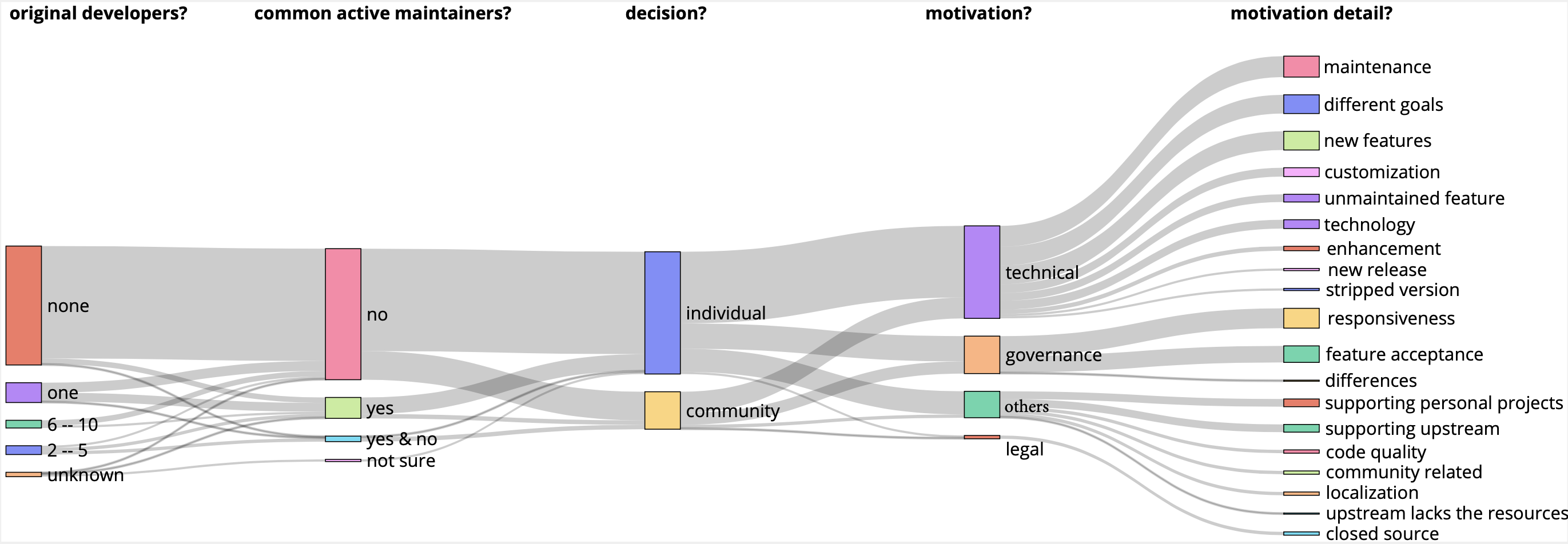
Illustrative view of the forces that shape fork creation and maintenance, spanning technical, governance, legal, and coordination constraints.
Overview
Social coding platforms make it easy to create forks, but they do not explain why some forks become durable variants instead of short-lived experiments. This project explores the motivations behind variant forks, asking whether the main drivers are technical divergence, governance preferences, licensing issues, or other practical concerns.
The study surveyed 105 maintainers of active open-source variant projects on GitHub and extended prior work with finer-grained insights about why forks are launched and what impedes their long-term co-existence. The result is a more grounded understanding of the social and organizational context behind software variants.
What the project focuses on
Why maintainers create variant forks instead of contributing upstream.
The technical, governance, and legal factors that sustain divergence.
Impediments to sharing work back across related projects.
Practical consequences for maintenance and coordination across forks.
Key takeaways
Shows that motivations for variant forks are more varied than prior coarse-grained categories suggested.
Documents concrete barriers that make ongoing co-maintenance difficult.
Provides empirical grounding for tooling and process support around long-lived forks.
Why it matters
Understanding why forks exist is a prerequisite for building better synchronization tools. If divergence is driven by more than code, then maintenance support has to account for social and organizational realities too.